The Health Promoters
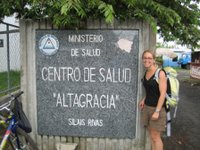 Getting to Ometepe involved a two hour drive in Saul’s pickup truck from Managua to San Jorge, and then an hour-long ferry ride to the island. The trip was made ever the more difficult because Saul was bringing a large whiteboard to the Health Clinic on the island. The ferry from San Jorge arrives in the village of Moyogalpa, but the class was on the other side of the island in the town of Altagracia. Getting to Altagracia required a taxi, but finding a taxi that could take a large whiteboard was not so easy. Eventually we found a large van and were able to tie the board to the roof. Tying things to the roof of a vehicle is quite common practice here in Nicaragua
  (chickens, bananas, sacks of flour), and I’ve never seen anything fall from a moving vehicle. That is until Friday. Because after driving for ten minutes we heard a loud THUD and turned around to see the whiteboard on the road behind us. Remarkably, it didn’t crack, but the wooden frame splintered into many pieces.
 The fall of the whiteboard turned out to be an omen for a long and unpleasant taxi ride, because soon afterwards it started raining, and then we found ourselves stuck behind a flag relay that consisted of a Nicaraguan child running with a flag for a few minutes and then passing the flag to another child who would continue down the road, etc. It apparently is a nationwide event in that the flag is carried by schoolchildren across the entire country, much like the Olympic torch relay. So we found ourselves going about 3 miles per hour in back of a 10-year-old boy who is jogging with an outstretched arm proudly holding aloft the Nicaraguan flag. And the police escort wouldn’t let us pass.
When we finally got to the health center in Altagracia, we then received the bad news
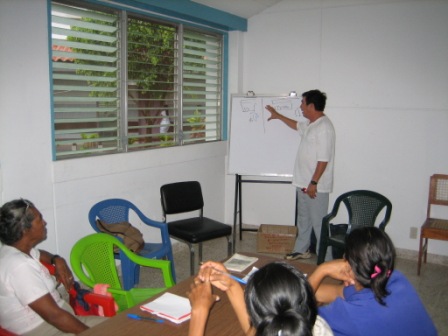 that many of the health promoters had not been able to come to the meeting because the heavy rains had made travel impossible on the dirt roads of their villages. Just as Saul was ready to cancel the class, however, some of the promoters trickled in, and we were able to hold the class for the 10 people who showed up.
Inspiring, is really the best adjective I can think of to describe Saul’s class. The health promoters were mostly poor farmers without a great deal of education. Yet, he really connected
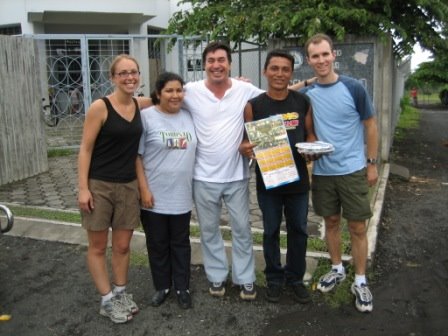 to them in a meaningful way by emphasizing the interconnectedness of community health. That is to say, if your neighbors don’t have a latrine, and your family does, then you should be happy, right? Wrong. Because if your neighbors don’t have a latrine, they’ll go to the bathroom outside, and insects will land on the human waste and then fly over to your house and get you sick. So it’s to the benefit of all members of a community that everyone stays healthy and that everyone has clean water and a hygienic bathroom/latrine.
posted by Jamie @ 9:57 AM
6 comments


6 Comments:
Write more, thats all I have to say. Literally, it seems as though you relied on the video
to make your point. You definitely know what youre talking about, why
waste your intelligence on just posting videos to your weblog when you could
be giving us something informative to read?
Have a look at my web page: 18 inch dishwasher
I always used to study post in news papers but now as I am a user of web so
from now I am using net for articles or reviews, thanks to web.
Review my web page :: www.mikemcmann.net
That is a great tip especially to those fresh to the blogosphere.
Short but very accurate info… Thank you for sharing this one.
A must read post!
Feel free to visit my blog post; custom seat covers
It's amazing to pay a visit this web site and reading the views of all mates about this article, while I am also eager of getting experience.
Visit my webpage :: custom cushions
Great delivery. Solid arguments. Keep up the amazing spirit.
Stop by my web-site HTTP://viavio.net/
I go to see everyday a few web sites and websites to read articles, however this blog offers feature based posts.
Check out my homepage: dishwashers uk
Post a Comment
<< Home